
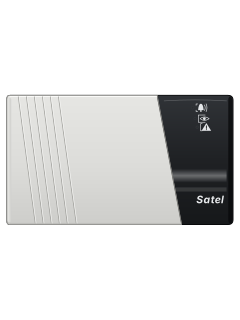
INT-KLCD / CA-64KLCD keypad, older grey case (flap closed)

Satel INTEGRA Plus manuals
Start hereINTEGRA Plus Control Panel User ManualUser guide · 58 pages · 1.7 MBRead it nowKeypad cheat sheet
Arm (away)your code#oryour code##
- Key in your code and press # (or OK). If you look after one partition, arming starts straight away with three short beeps.
- Several partitions? ARM ALL shows: press # again. Or press ▼ to ARM SELECTED and #; scroll to each partition, press any number key to mark it, then #.
- The exit delay may give a long beep every 3 seconds, then short beeps near the end. The green eye light comes on once armed.
- One long beep: zones are open or bypassed. If arming is refused, press 2 to list the open zones; 4, then 1, bypasses the one showing.
- Quick arming, if your installer allows it: 0 then # arms fully without a code.
Arm while home2#or3#
- Satel calls this arming without interior: inside zones stay off so you can stay in, if your installer has set zones up that way.
- Quick way, if your installer allows arming without a code: 2 then #. 3 then # does the same with no entry delay.
- Or use the menu: your code, *, ▼ to ARMING MODE, #, pick the mode, #. At ARM press #, mark the partitions with any number key, then #.
- In this mode an outside zone going off gives a silent alarm; any other alarm zone sounds loud.
Disarmyour code#oryour code##
- During the entry delay the keypad may give two short beeps every second.
- Key in your code and press #. With one partition armed, it disarms straight away, with three short beeps.
- With several armed, DISARM ALL shows: press # again. The same keys also clear an alarm.
- Under threat, use a duress code if one has been set up for you. It triggers a silent alarm and reports it to the monitoring station.
- Three wrong codes may set off an alarm or lock the keypad for 90 seconds.
Bypass a zoneyour code*41then#
- Satel calls a bypass until the next disarm inhibiting. The partition must be disarmed, and your code needs the right.
- Key in your code and press *, then 4 and 1 (Inhibit). The first zone you can bypass shows.
- Find the zone with ▼ or ▲ (or press 0 and key in its number). Press any key 1 to 9 until the inhibit symbol shows.
- Press # to save and leave. 4 then 2 (Isolate) bypasses a zone until you put it back, if your code is allowed.
- To put a zone back, do the same and press 1 to 9 until the dot symbol shows.
Alarm memoryyour code*52orhold5
- A red bell light on or flashing means an alarm or an alarm memory. Your code then # clears an alarm, if your code is allowed to.
- After clearing, your code then * gives View clear. al.: press # to see which zones set it off.
- For the event log: your code, *, then 5 and 2. The newest event shows first; ▲ goes to older ones.
- Or hold 5 for about 3 seconds to see the alarm log, if your installer has turned that on.
- The event log doesn't show panic alarms or duress alarms.
Chime on or offhold8
- Chime is five short beeps from the keypad when a zone such as a door opens while disarmed. Your installer picks the zones.
- Hold 8 for about 3 seconds, if your installer has turned this key on.
- Four short beeps and a long one: chime on. Three short beeps: chime off.
- With the right, you can also switch it in the user menu: CHANGE OPTIONS, then KEYPAD CHIME.
Panic alarmholdSHIELD
- Hold the key with the shield picture for about 3 seconds. It's * on some keypads and # on others: see the table below.
- Don't hold the flame key by mistake: it raises a fire alarm. 0 (with the exclamation mark) raises a medical alarm.
- They work only if your installer allows alarms from the keypad. Your installer also decides if the panic alarm is loud or silent.
- No pictures on your keys (INT-KLCDK)? Ask your installer which key raises a panic alarm.
Pages 10 to 12, 30, 58 of the INTEGRA Plus Control Panel User ManualINT-KLCD, INT-KLCDR Shield on *, flame on # INT-KLCDS, INT-KLCDL, INT-KLFR Shield on #, flame on * Change a codeyour code*1new code#
- Key in your code and press *, then 1 (Change own code). Your code needs the right to change it.
- Key in your new code and press # (or OK) to save. * leaves without saving.
- Codes are 4 to 8 digits; your installer can set a longer minimum.
- Change the factory master code before the system is used.
Test the systemyour code*
- Key in your code and press *. Press ▼ to TESTS and press #, then ▼ to ZONES TEST and press #.
- At NEW press #. Choose burglary zones, fire and technical zones, or one zone, and press #.
- Mark the partitions, key in the test time (50 minutes at most) and press #. Any number key adds a keypad chime; # starts the test.
- Open and close each door and window, and walk past each detector. Zones don't set off alarms during the test.
- Check the list with VIEW RESULTS in ZONES TEST. FINISH TEST stops it early.
Trouble lightsyour code*7orhold7
- Key in your code, press *, then 7 (System state) to see the troubles. Or hold 7 for about 3 seconds, if turned on.
- Hold 6 for about 3 seconds for the trouble log, if your installer has turned that on.
- Two long beeps: wrong code, or that function isn't available.
- If your installer turned on Grade 3, the red light shows alarms only after a code and *, and the yellow light also flashes for bypasses or an alarm.
Pages 11 to 14, 17, 22 of the INTEGRA Plus Control Panel User ManualGreen eye light on All partitions this keypad covers are armed Green eye light flashing Some are armed, or the exit delay is running Red bell light on or flashing Alarm, or alarm memory Yellow triangle light flashing Trouble, or trouble memory Green spanner light flashing Service mode is on Two short beeps every 3 seconds A new trouble Continuous beep Alarm Long beep every second Fire alarm
Why is my keypad beeping or showing a trouble light?
Most keypads beep or light up a trouble indicator when something needs attention, such as a low backup battery, a power cut or a lost phone or internet connection. Your user guide explains what each light or code means on your model. If it keeps happening, or you are not sure, call your installer or monitoring company.
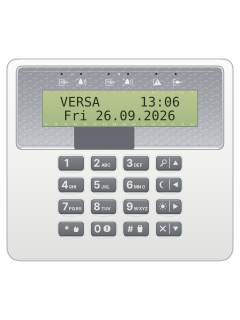
Is anyone watching your alarm?
An alarm that only makes a noise relies on someone hearing it. A monitored alarm reports to our A1 graded, NZSA approved control room, watched 24/7 by a team that is New Zealand owned and operated. We can monitor most existing alarms, so you may not need a new one. Thinking about a new alarm or security cameras? Ask us for a quote.
Prefer to talk now? Call us on 0800 339 999.
Home: alarm monitoringBusiness: business monitoringInstaller: bureau monitoring

Manuals are the property of their manufacturers and are provided for reference only; their inclusion here does not imply any endorsement by the manufacturer.