
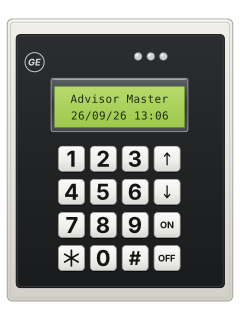
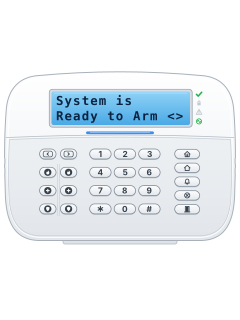
ATS1100 / ATS1105LCD arming station (GE badged)
Aritech Advisor Master manuals
Start hereATS2000-3000 Control Panel Installation and Quick Programming GuideQuick guide · 20 pages · 583 KBRead it nowKeypad cheat sheet
Arm (away)your codeON
- Close the doors and windows. The display should read There Are No Alarms In This Area.
- Key in your code (PIN), then press ON. Some keypads have # in place of ON.
- If a list of areas shows, press 0 then # (ENTER on some keypads) to arm them all, or an area number then #, and # again when done.
- Leave by your usual route before the exit time runs out. On keypads with area lights, the area light comes on once it's armed.
- Seven quick beeps with Active On mean a zone is open, such as a door: close it and try again. Without Active On, the code is wrong or not allowed at this keypad.
Disarmyour codeOFF
- Come in by your usual entry route and go to the keypad before the entry time runs out.
- Key in your code, then press OFF. Some keypads have * in place of OFF.
- If a list of areas shows, press 0 then # (ENTER on some keypads) to disarm them all, or an area number then #, and # again when done.
- The area lights go out, on keypads that have them. Disarming also resets an alarm, so check afterwards what set it off.
- Under threat, if your system uses duress: key in your code with its last digit one higher (a 9 becomes 0), then OFF. It disarms and sends a silent alarm.
Bypass a zone*your code#10#zone#
- Each detector or door contact is a zone; Advisor calls bypassing inhibiting. Press * (MENU* on some keypads), key in your code, then # (ENTER on some keypads).
- Key in 10, then #. Open zones are listed, or All Zones are Normal shows.
- Key in the zone number and press # to inhibit it. It drops off the list.
- Press # to leave the option, then 0 and # to close the menu.
- Unless your installer changed it, the zone stays inhibited until its area is next disarmed. Option 11 (Uninhibit Zone) puts it back sooner.
Alarm memory##
- During an alarm, There Are No Alarms In This Area leaves the top line, and on keypads with area lights that area's light flashes.
- To reset it, key in your code and press OFF. If areas are listed, key in the number of the area in alarm, then # (ENTER on some keypads).
- Later, with the normal display showing, press # twice to list recent alarms. No code is needed.
- Each shows its time, date, type and where, newest first. # steps back through them, NEXT (on keypads that have it) forward, 1 shows it all, 0 exits.
- Engineer reset req with a code on the display means your installer must reset it: give them the code.
Local alarm##0#
- Local Alarm on the display means a 24-hour zone, such as a fire door, went off while the area was disarmed.
- The keypad may give a broken tone, and an area light may flash. It's for someone on site to deal with.
- Press # twice (ENTER on some keypads) to see which zones caused it.
- Press 0 then # to acknowledge it. Some systems ask for a code to reset it.
- Fix the cause, such as closing the door. If reminders are set up, it alarms again after a set time until you do.
Change a code*your code#14#new code#
- This works if your installer has set your code to change only its own PIN. Press * (MENU* on some keypads), key in your code, then # (ENTER on some keypads).
- Key in 14 and press #. PIN Code: shows with your current PIN, or PIN Codes Can Not Be Displayed if PINs are hidden.
- Key in the new PIN (at least 4 digits) and press #. With PINs shown, the top line changes to the new PIN.
- With PINs hidden, Confirm PIN Code asks you to key the new PIN in again.
- It can't be another user's PIN or duress code. Press # to leave, then 0 and # to close the menu.
Set the date and time*your code#15#2#
- Press * (MENU* on some keypads), key in your code, then # (ENTER on some keypads). Key in 15, then #, for Time and Date.
- Key in 2, then #, to set the clock: Hours: shows. (1 only shows the time.)
- Key in the hour as 2 digits on the 24-hour clock and press #. Then the minutes, and #.
- Then the day, the month and the year, 2 digits each, pressing # after each one.
- You can't stop part-way: press # to keep any value that's right. Then press 0 and # until Code: shows again.
Test the system*your code#12#zone#
- Press * (MENU* on some keypads), key in your code, then # (ENTER on some keypads). Key in 12, then #, for Test Zone.
- Key in the zone number and press #. The display shows NORMAL STATE, ACTIVE, OPEN or SHORT.
- Walk past the detector, or open the door. It should read ACTIVE, with a steady tone until it's back to normal.
- OPEN or SHORT means a fault in the zone's cabling. Press # to finish; the test also ends after a set time.
- Siren test, if your code allows it: menu option 7, your code, #, then 7 and #. The inside siren sounds for 3 seconds, then the outside siren and strobe.
Trouble lights*your code#1#
- A system alarm comes from a tamper, a lost connection, or a fault such as mains fail or low battery.
- If your installer turned it on, the keypad buzzer sounds for a mains or phone line fault; if not, only a light flashes.
- Depending on how your system is set up, a system alarm clears by itself once fixed, or needs a code that's allowed to reset it.
- For the full list, press * (MENU* on some keypads), key in your code, then #; then 1 and # (Panel Status).
- Each zone shows a letter: A alarm, T tamper, i inhibited, a active (open). NEXT (on keypads that have it) updates the list; # leaves.
Pages 6, 8, 18 and 19, 22, 24, 26 of the ATS2000-3000-4000-4500 Advisor Master Manager's Guide v1.0 2003Page 1 of the 1045089 ATS1100-1105 8-Area LCD RAS Installation SheetArea light on (where fitted) That area is armed Area light flashing (where fitted) An alarm in that area: slowly if it was disarmed, fast if armed Green Mains light on (ATS1100) Mains power is on Red Alarm light on (ATS1100) An alarm in an area this keypad covers Yellow Fault light on (ATS1100) A fault somewhere in the system Comms Fail light (some keypads) The panel can't reach your monitoring centre RAS, DGP or Battery Fail light (where fitted) A keypad or expander (DGP) is off-line, or the battery is low Engineer reset req and a code on the display Your installer must reset it, such as after a tamper: give them the code
Why is my keypad beeping or showing a trouble light?
Most keypads beep or light up a trouble indicator when something needs attention, such as a low backup battery, a power cut or a lost phone or internet connection. Your user guide explains what each light or code means on your model. If it keeps happening, or you are not sure, call your installer or monitoring company.
All Aritech Advisor Master manuals
Installer manuals 4
Nothing here matches that.
Try a shorter search, or search every brand.
More Aritech models
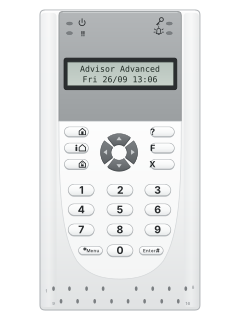
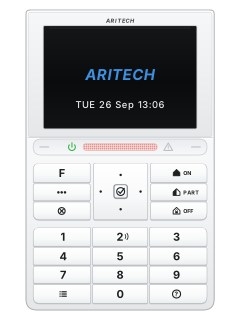
Is anyone watching your alarm?
An alarm that only makes a noise relies on someone hearing it. A monitored alarm reports to our A1 graded, NZSA approved control room, watched 24/7 by a team that is New Zealand owned and operated. We can monitor most existing alarms, so you may not need a new one. Thinking about a new alarm or security cameras? Ask us for a quote.
Prefer to talk now? Call us on 0800 339 999.
Home: alarm monitoringBusiness: business monitoringInstaller: bureau monitoring

Manuals are the property of their manufacturers and are provided for reference only; their inclusion here does not imply any endorsement by the manufacturer.