
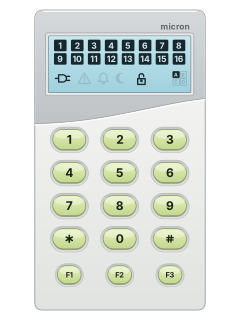
Icon LCD keypad

Micron Z8040 - 16040 manuals
Start hereScorpion Z16040C / Z8040C / Z5120C Features and OperationUser guide · 36 pages · 730 KBRead it nowKeypad cheat sheet
Arm (away)your code#or9#
- Use a numbered keypad to arm away. For NiteWatch, see Arm while home.
- Key in your code (2 to 8 digits), then #. The keypad sounds a tone and shows the zones being armed.
- Walking out past detectors makes their zones flash and slows the tone. If a zone keeps flashing, disarm, fix it and arm again.
- When the exit time ends, the zones go out and the tone stops. The LCD keypad's padlock locks.
- Without a code: 9 # arms every area not yet armed, unless your installer switched it off; 1 # to 4 # arm area A, B, C or D.
Arm while home*91or*96ARM
- Scorpion calls this night arming. Only the night zones your installer chose are armed.
- Press *, 9, 1. The system arms silently while the exit time runs; the LCD keypad shows a moon. When the night zones go out, it is armed.
- In delayed mode, a night zone may give an entry warning. Disarm with your code, then #, before it ends.
- *, 9, 6 arms the night zones instantly, with no delay. Areas B to D use *92 to *94, or *97 to *99.
- NiteWatch: press ARM to night arm area A, if your installer has kept that function for the key.
Disarmyour code#
- Use a numbered keypad. Night arming needs a code to disarm; the NiteWatch station cannot enter one.
- Key in your code, then # before the entry tone ends. Two short beeps mean it has disarmed; one long beep means a wrong code.
- With areas, your code then 1 # disarms area A only (2 # for B, 3 # for C, 4 # for D).
- Under threat, key in your code and hold # until a second beep. It disarms and sends a duress code, if monitored.
Bypass a zone*11your code*zone##
- Use a numbered keypad to bypass zones.
- Scorpion calls this excluding or bypassing. Your installer decides which codes can do it and which zones can be left out.
- Press *, 1, 1, key in your code, then press *. All zone numbers show.
- Key in a zone number, then #. Its number flashes. Repeat for more zones.
- Press # once more to arm. The bypassed zones go back to normal when you next disarm.
Alarm memory*80
- Use a numbered keypad to view alarm memory.
- In an alarm, the zones that went off flash with the area; the LCD keypad also flashes the bell.
- Press *, 8, 0 to see the latest alarm. The first zone shown is the most recent.
- Press # to step back through older alarms, up to 128.
- Press any other key to leave. *, 8, 1 does the same for tamper alarms.
Chime on or off*71
- Use a numbered keypad. Your installer picks the chime zones, such as the front door.
- While disarmed, press *, 7, 1. Fast beeps for 3 seconds mean chime is on; two beeps mean it is off.
- A chime zone makes the keypad sound when it is set off, then waits for things to go quiet before chiming again.
- Areas B, C and D use *, 7, 2 and *, 7, 3 and *, 7, 4.
Reset smoke detectors*77
- Use a numbered keypad to reset smoke detectors.
- If your installer has set it up, press *, 7, 7 to reset a smoke detector that has latched after an alarm.
- The detectors then get 12 seconds to settle.
Panic alarm*+#or1+3or4+6
- Numbered keypad: press * and # together for a panic alarm.
- 1 and 3 together is a fire alarm, and 4 and 6 together a medical alarm.
- The alarm sounds and, if monitored, a signal goes to your monitoring station.
- On a Nitewatch station, EMERGENCY sends a panic alarm. That is how it comes set; your installer can change it.
Change a code*21master code#your code#new code#
- At a numbered keypad, press *, 2, 1, key in the master code, then #.
- Key in the old code, then #, then the new code (2 to 8 digits), then #.
- The new code keeps all the settings of the old one.
- Add a code: *, 2, 0, master code, #, new code, #.
- Delete a code: *, 2, 3, master code, #, the code to delete, #.
Trouble lights*83
- Use a numbered keypad to check faults.
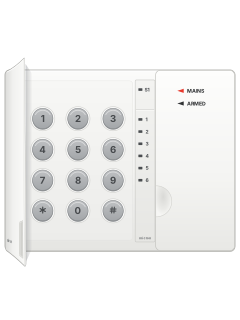
- A flashing system fault symbol (LCD keypad) or fast-flashing AC light (LED keypad) means a fault, or a panic.
- Press *, 8, 3. The zone lights show what happened (see the table).
- The power lead symbol (LCD keypad) or the green AC light (LED keypad) flashes during a mains power cut.
Pages 3, 5, 19 of the Z16040C User ManualPage 11 of the Scorpion Z16040C Z8040C Z5120C Installation Version 6 (print)1 Panic alarm 2 Battery flat or faulty 3 Mains power has failed 4 A report to the monitoring company failed 5 Phone line faulty or disconnected 6 12 V power overloaded 7 Siren fault 8 Duress used at a keypad
Why is my keypad beeping or showing a trouble light?
Most keypads beep or light up a trouble indicator when something needs attention, such as a low backup battery, a power cut or a lost phone or internet connection. Your user guide explains what each light or code means on your model. If it keeps happening, or you are not sure, call your installer or monitoring company.
All Micron Z8040 - 16040 manuals
User guides 2
Installer manuals 2
Nothing here matches that.
Try a shorter search, or search every brand.
More Micron models
Is anyone watching your alarm?
An alarm that only makes a noise relies on someone hearing it. A monitored alarm reports to our A1 graded, NZSA approved control room, watched 24/7 by a team that is New Zealand owned and operated. We can monitor most existing alarms, so you may not need a new one. Thinking about a new alarm or security cameras? Ask us for a quote.
Prefer to talk now? Call us on 0800 339 999.
Home: alarm monitoringBusiness: business monitoringInstaller: bureau monitoring

Manuals are the property of their manufacturers and are provided for reference only; their inclusion here does not imply any endorsement by the manufacturer.